Reading a Phase 1 and Phase 2 Gold Drill Report
Grams per tonne, intercept width, true thickness. A short guide to the numbers a drill program actually produces.
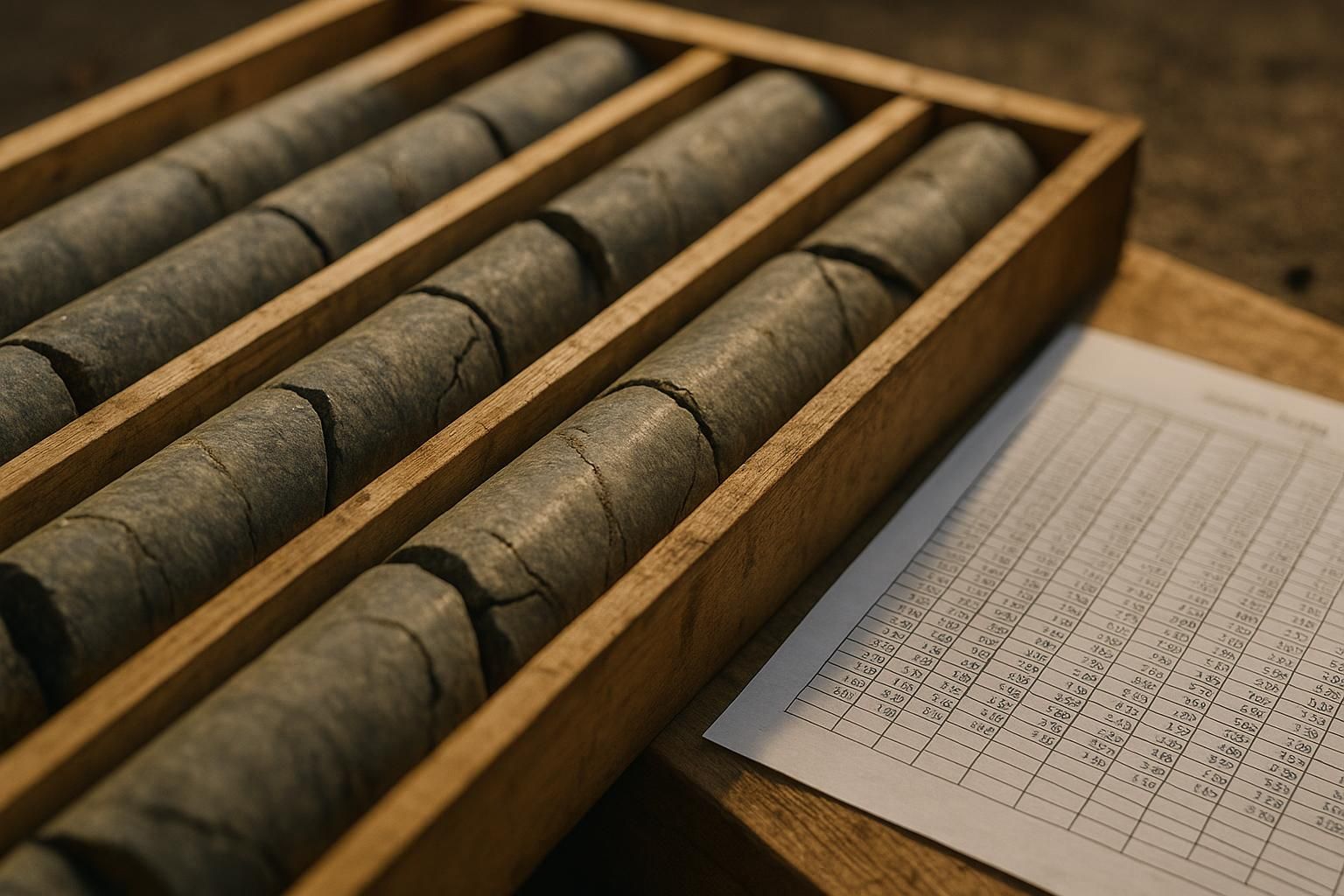
A drill report is where a gold exploration story stops being a geological idea and starts being data. Companies drill in phases, a first program to test whether a target holds anything, a second to follow up on what the first found, and each phase produces a set of numbers that a news release then translates into excitement. Learning to read those numbers yourself, using a project like Twin Peaks as the frame, is the difference between evaluating a discovery and taking a promoter's word for it.
Grade: grams per tonne
The headline number in any gold intercept is grade, usually quoted in grams per tonne, written g/t. It is how much gold sits in a tonne of rock. Context: many open-pit gold mines work ore around one to two g/t, while underground operations need higher grades to justify the cost. So an intercept of five g/t is genuinely high grade, one g/t is modest but potentially mineable in bulk, and a fraction of a gram is often uneconomic. Grade alone means little without width.
Width, and the true-thickness trap
The second number is the width of the intercept: how many meters of the drill hole returned that grade. "Ten meters at five g/t" is a very different result from "one meter at five g/t." But here is the trap. The width reported is usually the length along the drill hole, not the true thickness of the mineralized zone. If the hole cut the zone at an angle, the true thickness can be far less than the drilled length. A careful report states true width or notes that it is unknown. A promotional one quotes the longer number and hopes you do not ask.
- Grade (g/t)
- Gold per tonne of rock; higher is better, but needs context
- Width (m)
- Meters of mineralized core; along-hole, not always true thickness
- Cut-off
- The minimum grade counted; a low cut-off flatters results
- Gram-meters
- Grade times width, a rough way to compare intercepts
The tricks to watch for
A few common techniques inflate a result without lying outright. A low cut-off grade sweeps marginal rock into the intercept to make it look wider. Averaging across a long interval can bury a short high-grade hit inside meters of waste, producing a headline grade that no continuous zone actually holds. And cherry-picking the best hole from a program while burying the misses gives a false picture of the whole target. Read the full results table, not just the release headline, and look for the holes that are not being talked about.
One great hole is a data point. A pattern of holes that connect is a discovery. Promoters sell the first as if it were the second.
From intercepts to something real
A single strong intercept, even a spectacular one, is not a resource. It tells you gold is present at that spot. What turns scattered intercepts into an asset is continuity: enough holes, close enough together, showing the mineralization connects into a body big and consistent enough to model and eventually mine. Phase 1 and Phase 2 programs are usually far too early for that. They are looking for a reason to keep drilling, and a good result at this stage is permission to spend more, not proof of a mine.
The standard to hold
Serious results are reported to a recognized code, and the assays come from an independent laboratory. Treat visual estimates and un-assayed "mineralization" as marketing until the lab confirms them. For the physical reality behind these numbers, see what a junior gold drilling program actually involves, and for the specific ground, our coverage of the Twin Peaks gold-silver project. This is educational analysis, not investment advice.
Related Coverage
Twin Peaks: A Gold-Silver Exploration Story in Yavapai County
An exploration property in Arizona's Eureka Mining District, near Bagdad, has drawn small-cap attention for years. What the ground actually holds.
Picacho-Salton: Gold on the Edge of the Mesquite District
A cluster of lode and placer claims in Imperial County sits beside one of California's few operating gold mines. Geography is doing a lot of work here.
What a Junior Gold Drilling Program Actually Involves
From claim maps to core boxes, a drilling campaign is slower and more expensive than a news release makes it sound.
US Gold Exploration Projects Worth Watching in 2026
A tour of active exploration ground across Nevada, Arizona, and California, and how to judge which stories have substance.